25 Women
Who Ministered to Men in the Bible:

By Reverend Mombo Galloway
Introduction:
Nowhere in the Bible does it say women are to minister only to other women and children. In fact, the Word of God teaches the opposite. Yet, many Bible-believing churches and denominations have accepted this false cultural bias as a fact. This has become an acceptable way to place over 1/2 of the population in a status of non-influence within the leadership of the church/missions/ministry to the world. A church with no women in leadership partnering alongside the men is like having a home with a dad but no mother or no mother that partners alongside him in leading the family. Imagine a home with small children at Christmas with a dad and a mother who has died. It would not be the same homey feeling at Christmas. Without the decorations, music, cookies, homecooked meals, and specially picked-out wrapped gifts, life just wouldn't be the same without a mother's leadership at home during the holidays. It would be home, yes, and the dad would try... sure... but not ideal, not as special, missing so much love and care. This is the same with our "church homes" around the world. It's ideal to have a mother and a father leading the home and leading within the house of God because a male and a female together reflect the nature of who God is as we are both made in His image. In creation, God said "let them rule" not "let him rule." The fall is a result of turning away from God, and horrific things were a result throughout the ages, slavery, abuse, neglect, and more. But if we have been made right with God in Christ Jesus, and now have received God's intended purposes for all of our lives, male and female, we can do all things through Christ Jesus and co-rule, co-lead as God intended.
BELOW IS A LIST OF 25 WOMEN WHO MINISTERED TO MEN IN THE BIBLE to show that yes, women can and should minister to men, just like men who minister to women in churches around the world. Sisters and brothers under Christ, not under each other. It's time for reformation in the church to mirror the truth of scripture. Here's mud in your eye so the blindspots can finally be washed away as we look at what the whole of scripture says about women ministering to men in God's Word.
- Mombo Galloway
University of the Nations - Kona
Youth With A Mission

25 Women
Who Ministered to Men in the Bible:
1. Eve
Genesis 2:18 “Then the Lord God said, It is not good that the man should be alone; I will make him a helper (In Hebrew also means minister) fit for him.” Therefore, in the beginning, Women were made in creation to minister to men. “So God created man in his own image, in the image of God he created him; male and female he created them.” Women were created in the image of God. In the image of the Father/Son/Holy Spirit; Not a “less than” image. The same anointing of a God image bearer and a witness is within the woman as it is in the man. In addition, God ministers to women and men. Men minister to women and men. Women minister to women and men. It’s that simple.
2. Miriam
Micah 6:4 “I brought you up out of Egypt and redeemed you from the land of slavery. I sent Moses to lead you, also Aaron and Miriam.” Miriam was leading the Israelites (men and women) for the purposes of God, just like her brothers. She also led men and women into victory across the red sea and led men and women in worship.
3. Deborah
An honored and respected Judge, Deborah excelled in multiple areas. She led as a prophet, judge, military leader, songwriter, and minstrel. Deborah summoned Barak and told him the Lord commands him to position himself at Mount Tabor and bring 10,000 warriors. The Lord spoke through her to Barak to share His strategy and promises of deliverance and victory. Judges 4:5-7 She judged under a palm tree, a setting rabbinic tradition maintains, that validated her openness, fairness, and refusal to show partiality. The Bible records no dissent or rebellion against her. Leadership resides not in gender but in character and gifting. The Israelites recognized her abilities and prospered under her tenure. Deborah calls herself a mother of Israel. (5:7) As we all understand, a mother and a father have authority given by God to lead and train up both males and females. Deborah led Israel for 40 years from 1107 BC until her death in 1067 BC.
4. Huldah
Huldah appears in the Hebrew Bible in only nine verses, 2 Kings 22:13-20, 2 Chronicles 34:22–28. This short narrative is sufficient to make clear that Huldah was regarded as a prophet accustomed to speaking the word of God directly to high priests and royal officials, to whom high officials came in supplication. She told kings and nations of their fates, had the authority to determine what was and was not the genuine Law, and spoke in a manner of stern command when acting as a prophet. “Hilkiah the priest, Ahikam, Akbor, Shaphan, and Asaiah went to speak to the prophet Huldah… She said to them, “This is what the Lord, the God of Israel, says: Tell the man who sent you to me…” Again another example of a woman ministering not just to men, but to leaders and priests.
5. Judith
To remain ecumenical, for the catholic theologian, I am including Judith from the book of Judith in the catholic old testament bible which is considered Apocrypha literature by the protestants. Judith, instead of going to Bethulia’s leaders, summoned them to her home (Judith 8:10). Chiding them for testing God (Judith 8:11–12), she declared she had a plan to save Bethulia, Jerusalem, the Temple, and the people. Declining to reveal it, she nonetheless proclaimed her deed will “go down through all generations of our descendants” (Judith 8:32). Not only did the leaders listen to Judith without interruption, but they also acclaimed her for her wisdom and—like all men in this tale, do her bidding (Judith 8:28–29).
6. Hannah
Hannah was considered to be a prophetess. I want to bring to light a portion of scripture where she decided to do something different than her husband and family, presumably under the unction of the Holy Spirit. In going against his plans and making her own, her husband is actually understanding and supportive of her which is a response not commonly valued in marital authority in a patriarchal society. Samuel 1:21-22 “When Elkanah next took his family on their annual trip to Shiloh to worship God, offering sacrifices and keeping his vow, Hannah didn’t go. She told her husband, “After the child is weaned, I’ll bring him myself and present him before God—and that’s where he’ll stay, for good.” Elkanah said to his wife, “Do what you think is best.” If only we who are married would respond this way to each other more when our spouse differs from us. If we were to put an understanding hand on their shoulder, look them in the eye and smile, and say sincerely “do what you think is best.” This portrays confidence and trust in the others' ideas even if it diverges from the traditional family customs. Though not teaching a man directly here, I felt it was noteworthy in that he submits to his wife which foreshadows the New Testament verse instructing us to "submit to one another."
7. Jael
Jael was a woman in the Bible who helped the Israelites subdue Jabin the Canaanite king by single-handedly killing the commander of his army, Sisera. Her story is found in Judges 4:17-24. Killing the commander of an attacking army against Israel was not just a soldier’s act but what victorious military heroes are honored for. Jael took the bull by the horns and took care of business, ugly business, that trumped the meek and mild stereotype of BC women. Jael took a tent peg and hammer in her hand and snuck up going "softly to him" (Judges 4:21). She then “drove the peg into his temple until it went down into the ground while he was lying fast asleep from weariness. So he died" (Judges 4:21). Thus Deborah's prophecy that "the LORD will sell Sisera into the hand of a woman" came true (Judges 4:9). Did she minister to men? Well, maybe not the man she killed, but to the men and women of Israel, yes. She was an example of wit, fortitude, and strength.
8. Jehosheba
As mentioned in 2 Kings 11:2 and 2 Chronicles 22:11 Jehosheba was the daughter of King Jehoram. She became the wife of the high priest, Jehoiada. This is the only instance of a princess marrying a high priest. She was also the courageous woman who rescued her nephew Joash, to save his life from being murdered. Jehosheba has the credit of preserving “The Seed Royal,” for had Joash also perished the line of Judah would have been made extinct. Her husband the priest then set her nephew Joash as King and was free to make a covenant between the Lord and the new king and the people that they would be the Lord’s people. “All the people of the land went to the temple of Baal and tore it down. They smashed the altars and idols to pieces and killed Mattan the priest of Baal in front of the altars.” This would not have happened without the boldness and risk of Princess Jehosheba saving the future king, the line of Judah, and together with her husband bringing the Israelites back to serving the Lord.
9. Esther
This is the one "female story" most Christians know. Therefore I will address that she along with many of these female heroes of the Bible risked her life for the sake of men and women in the name of God. She broke the rules by entering the throne room uninvited and speaking when not being spoken to first by the king. She stood for God’s people and turned the heart of the King through prayer, fasting, and obeying what God told her to do. She ministered to her husband the king as she guided him to make choices that would please the Lord and save the lives of a generation of Jewish families.
10. Anna
Luke 2:36-38 “There was also a prophet, Anna, the daughter of Penuel, of the tribe of Asher. She was very old; she had lived with her husband seven years after her marriage and then was a widow until she was eighty-four. She never left the temple but worshiped night and day, fasting and praying. Coming up to them at that very moment, she gave thanks to God and spoke about the child to ALL who were looking forward to the redemption of Jerusalem.” She spoke to all "of the messiah", both men and women. The first female preacher of the New Testament.
11. Junia
Once thought to be a man’s name by possibly biased male scribes, it has now been proven from multiple historic sources that Junia has only been used as a female name in her time period. In Romans 16:7 Paul says, “Greet Andronicus and Junia, my compatriots and my fellow prisoners. They are well known to (or prominent among) the apostles, and they were in Christ before me." We usually think of the apostles as the 12 disciples that followed Jesus during his time on earth but we must remember that in The Upper Room and also at the Ascension that there were many followers of Jesus, male and female, that were commissioned to go into the world and preach the gospel. At that moment, all of those who decided to follow these instructions male and female were then considered apostles. This would help us to understand why Paul calls Junia not just an apostle but one of the “well-known” apostles. Strong's biblical concordance says apostle/Apostolos in Greek means: a messenger, one sent on a mission. Surely the men and women in the upper room and the men and women at the ascension were sent by Jesus on a mission to the world to proclaim the gospel. We don’t know if Junia was a follower of Jesus while he was on earth or if she came to the faith after, but we do know that if she had been put in prison for proclaiming the gospel along with Paul and Andronicus then she most likely taught the men and women in the early church just like all of the other followers of The Way who were imprisoned for doing so.
12. Phoebe
Since we are already here in Romans 16 regarding Junia, I would be remiss to not tell you that Romans 16 is the "mother-load" of women in ministry in scripture. It is a shame that women are not familiar with Roman’s 16. Not including wives, mothers, sisters, and daughters that are mentioned there, we find up to 9 women who serve in ministry in the churches listed in this one chapter. Phoebe is the first one mentioned. Paul says “I commend to you our sister Phoebe, a deacon of the church in Cenchreae. I ask you to receive her in the Lord in a way worthy of his people and to give her any help she may need from you, for she has been the benefactor of many people, including me.” I want to point out that he is not saying she is there to help them, though she is, he is instructing the men and women to help her. She is the leader to be offered help. She is the one carrying the gospel letter message to the church in Rome which by anyone’s standard was an intimidating, highly educated, anti-Christian city. As the gospel messenger, it would be her duty to read the letter and explain it to the church in Rome and the other places she was sent to proclaim the gospel mentioned and therefore minister to men and women in the church. The Word also shows Phoebe as a “benefactor”. In Greek, a benefactor is someone who’s a donor yes, but also the word is connected with a presenter. Someone who presents to groups of people, men, and women. She is also wealthy and some theologians concur, possibly a business owner.
13. Priscilla a.k.a. Prisca for short by close friends
Paul lived with Priscilla and her husband Aquila for a year and a half. Priscilla and Aquila were early church pastors that ministered to men and women in their congregation. To the Corinthians, Paul wrote, “Aquila and Priscilla salute you much in the Lord, with the church in their house.” They are mentioned six times in the New Testament together with her name being ahead of her husband's four times and his being mentioned ahead of his wife two times. Four of six times having the wife’s name ahead of the husband which is different even by today’s standards speaks to her leadership. This seems to imply that she was an equal leader if not a prominent leader of the church with her husband. If in any way, Priscilla outshone Aquila, he appeared to have no problem with his precious gifted wife and appeared to work together harmoniously with her as the two were inseparable in scripture. When they went on a mission trip with Paul to Syria, Cenchreae, and Ephesus where they relocated their ministry, they listened to Apollos preach boldly in Ephesus. Afterward, they took him aside so Priscilla & her husband taught Apollos, (a man.) “They expounded unto him the way of God more carefully.” What was the result of Apollos being trained not just in John’s baptism but the baptism of the Holy Spirit by Priscilla and Aquila? Apollos was then called an apostle that some Corinthians actually put above Peter and Paul. In addition, in Romans 16:4 Paul said “They (Priscilla and Aquila) risked their lives for me. Not only I but all the churches of the Gentiles are grateful to them.” Again, we see this wife and husband team risking their lives for Paul and possibly multiple men and women in multiple churches that are in return “grateful to them.” Eventually having their lives ended like most apostles, July 8th is the day set apart for them in the martyrology of the Roman Church when it is said the faithful couple were led out beyond the walls and beheaded for their faith. Examples of whose name was first in the text: (Acts 18:2: A & P fled Rome, 18: P & A go on a missions trip to Syria with Paul, 26: P & A taught apostle Apollos; Romans 16:3: P & A Church leaders who risked lives for Paul; 1 Corinthians 16:19 A & P greetings; 2 Timothy 4:19: P & A greetings.)
14. Mary
Again referring to the female minister, the "mother-load" of “Romans 16” briefly mentions a Mary as a woman in the church who worked very hard for her fellow believers.
15. Tryphena and 16. Tryphosa
Sisters, possibly twins, were greeted by Paul in Romans 16:12 “Greet Tryphena and Tryphosa, those women who work hard in the Lord.” These two sisters whose names mean dainty and delicate were not just church attenders, there were many church attenders. Paul is greeting the people “who work hard in the Lord.” They are the heavy lifters of the faith working within the church regardless of their quite delicate names.
17. Persis
In Romans 16 it lists “another woman who has worked very hard in the Lord.” I want to highlight the words worked, not attended, and not just worked but worked very hard. She was someone honored and respected by Paul. Otherwise, there would be no need to point out her accomplishments. We will end our names of women mentioned by Paul as close personal friends of his in the early church here even though there are more listed in the “mother-load” of Romans the “Sweet 16.”
18. Lois and 19. Eunice
It is in Acts 1:6 and 2 Timothy 1:5 that we find records of these women, but what a strong commendation the Apostle Paul gives to them. In 2 Timothy 1:5, Paul writes: “I have been reminded of your sincere faith, which first lived in your grandmother Lois and in your mother Eunice and, I am persuaded, now lives in you also.” These women were responsible for passing their faith on to the next generation. They were mentors in the faith to Timothy, a trusted companion in the ministry alongside Paul. The compelling feature of the scriptural record of Eunice and Lois is their religious influence on Timothy.
20. Lydia
The purple cloth lady; that’s about all most people know when they hear the name, Lydia. But, Luke, the author of Acts, records that Paul’s first ministry encounter in Philippi was not with a Macedonian man, but with a group of women, a group which included Lydia, a woman originally from Thyatira who was a business owner and a God worshiper. I suggest we are given this information because Luke uses her as an example of a significant woman. Women in the first-century Roman world, like Lydia, were entering the public sphere in business and as patrons, and they impacted the early church in those roles as well. Lydia was a seller of purple, that is, she was a businesswoman who sold luxury textiles dyed purple. It was only the wealthy elite who wore garments dyed purple or trimmed with purple. The expenses involved in her occupation as a merchant of luxury textiles indicate she was a woman of some wealth. Lydia’s wealth is also indicated by the fact that she seems to have been the owner and mistress of her own home. Acts 16:15. which begins with, “When she and her household (ho oikos autēs) were baptized. . .”—makes it clear that it was HER household. Furthermore, Lydia uses her own initiative and doesn’t consult a male relative, when she offers the missionaries hospitality, which they accept. There is no mention of a husband or a father in her story. This is unusual as women in Bible times were often identified by their relationship to a man: a father, a husband, an adult son, or even a brother. It is likely Lydia had no surviving adult male relatives. She was probably widowed or perhaps divorced. Divorce was easy under Roman law and it was common, and in most cases, it did not result in any sense of scandal or stigma. Whatever her marital status, Lydia’s home was relatively spacious. It was large enough to accommodate Paul and his fellow missionaries (who included Silas, Timothy, and possibly Luke and others) as well as her own household. Her home was also large enough to hold church meetings. It was in Lydia’s home that the church at Philippi first gathered, Acts 16:40. Lydia’s hospitality and her benefaction of Paul and his ministry required courage. Having a group of foreign men stay in her house might potentially cause scandal. Hosting meetings where they worshiped a new Jewish messiah, and not an emperor or any of the ancient and respected pagan gods, could have ruined her reputation and her business. Receiving Paul and Silas into her home after they were released from prison and asked to leave town, was brave, Acts 16:40. After Paul and Silas left the town, the church met in her home. As she was personally mentored by Paul and Silas we can assume she was not just a host but a newly appointed leader in this new church over men and women in Philippi. You will find future letters of encouragement to Lydia’s church in the book of Philippians.
21. Euodia and 22. Syntyche
In Philippians 4:1-3 Paul said “Therefore, my brothers and sisters, you whom I love and long for, my joy and crown, stand firm in the Lord in this way, dear friends! I plead with Euodia and I plead with Syntyche to be of the same mind in the Lord. Yes, and I ask you, my true companion, help these women since they have contended at my side in the cause of the gospel, along with Clement and the rest of my co-workers, whose names are in the book of life.” Both are women who Paul said, “contended at my side” in the cause of the gospel. Here it does not say they followed him, or helped him but fought alongside him in the preaching of the gospel. I am reminded of Eve being taken out of Adam’s rib, his side, not his foot, or his back, but his side. The way he references men and women in this verse portrays an intimate camaraderie with Paul's brothers and sisters together in Christ as friends working alongside him in the ministry; both men and women. Also, I would like to draw attention to the fact that it seems these two ladies may be having a problem with each other and need a little help from a brother. I love this because it shows that the women of the Bible are human, just like the men. That humanness does not disqualify them but endears them even more to each other. Sometimes there are higher standards put on women than on men when it comes to holiness and more. This should not be so. We are all sinners saved by grace and therefore are “in process” and a woman does not need to be “perfect” to be in ministry just like a man does not need to be “perfect.” Jesus is the only perfect one in the equation.
23. Mary Magdalene
There is a lot to say about Mary Magdalene. She was in the upper room on the day of Pentecost and prayed in tongues when she was filled with the Holy Spirit. In so doing she was given power from on high to be a witness to everyone, everywhere along with the other men and women present. But here I want to focus on how she was chosen by God to be the first person to share the resurrection, with men. Mark 16:9-14,“When Jesus rose early on the first day of the week, he appeared first to Mary Magdalene, out of whom he had driven seven demons. She went and told those who had been with him and who were mourning and weeping. When they heard that Jesus was alive and that she had seen him, they did not believe it. Afterward, Jesus appeared in a different form to the two of them while they were walking in the country. These returned and reported it to the rest, but they did not believe them either. Later Jesus appeared to the Eleven as they were eating; he rebuked them for their lack of faith and their stubborn refusal to believe those who had seen him after he had risen.”
24. The unnamed “Woman at the Well”
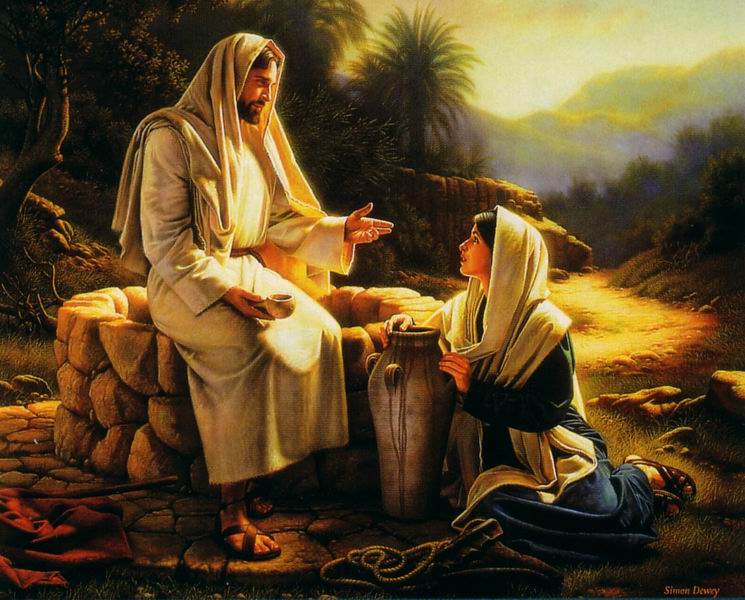
Again, a familiar story to most about Jesus sitting with a woman at the well, a sinner. It is interesting to point out he chooses to share a special secret with her in John 4:25-28, "The woman said, “I know that Messiah” (called Christ) “is coming. When he comes, he will explain everything to us.” Then Jesus declared, “I, the one speaking to you—I am he.” Jesus shares with this Samaritan sinner woman that he is the Messiah in a very matter-of-fact direct way. He has not been going around saying I am the Messiah. This is a really big deal that he picks her to tell this. It reminds me of the verse "I choose the foolish things of this world to confound the wise." He finds her worthy of this information not to just hold on to and believe in the quietness of the four walls of her home, but instead, without any training, any more knowledge than just finding salvation in Jesus, literally minutes after her interaction with him, she in verse 28 "Then, leaving her water jar, the woman went back to the town and said to the people…” She then tells the men and women of her town about Jesus, and was transformed from a woman hiding from them out of shame by going to the well in the middle of the day, to going up to men and women face to face and bringing them to Jesus.” She led them as an evangelist.
25. Johanna and (a bonus 26. Susanna)
Luke 8:3 “Joanna the wife of Chuza Herod's steward, and Susanna, and many others, who ministered unto Jesus and the disciples of their substance.” Even Jesus and the 12 disciples had women who ministered to them.